
|
|
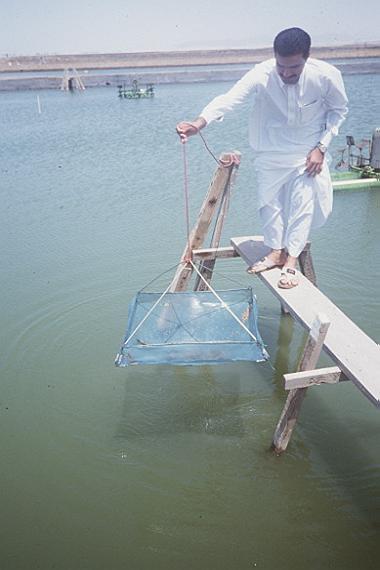 |
The paramount objective in feed monitoring is to adjust the daily feed ration as close as possible to the actual requirement. By so doing, growth and feed efficiency are optimized while water pollution pond and soil deterioration are minimized. To date, the most effective and practical approach to feed monitoring is with the use of the feed monitoring tray (Cruz, 1991). The feed monitoring tray is a simple tool used in feeding management. It is sometimes referred to as feeding tray, observation net, feed inspection tray or umbrella net. The tray operates based on the rate by which a particular population consumes a measured quantity of feed within a given span of time. Typically, the monitoring tray is square or rectangular with a fine-meshed nylon net bottom, supporting frame, sinkers and a retrieving rope. There are many design variations but all function by the same principle. The size of the tray is usually 0.4-0.6 m2. Size is not a critical functional parameter but bigger trays are preferred with high tray allocations (Cruz, 1991). Feed monitoring is started after the first bodyweight sampling, usually 30-45 days after stocking, and is employed thereon until the time of harvest. The monitoring tray may be accessed with the use of a catwalk, hooked pole, lift pole or feeding boat (Cruz, 1991). After use the monitoring trays are taken out of the pond and feed leftovers, if any, are discarded. To avoid clogging and fouling of the net and prevent the attachment of sessile pond organisms (e.g. barnacles, shipworms, filamentous algae), this should be cleaned regularly and left to dry under the sun. As part of maintenance, the tray bottom is regularly checked for holes or tears, or folds which may limit the accessability of the feeds placed inside (Cruz, 1991). |