
|
|
Phospholipids consist of glycerol in which positions 1 and 2 are esterified with fatty acids and position 3 with phosphoric acid and nitrogenous base. If the nitrogen base is choline or ethanolamine it is called lecithin or cephalin, respectively. Both are components of cell membranes and have roles in lipid digestion, absorption, and transport in the hemolymph (Akiyama et al., 1992). 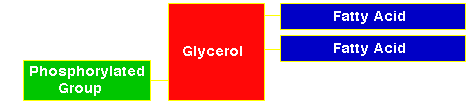 The beneficial effects of phospholipids on growth and survival of shrimp are well documented. It has been reported that
Recommended total phospholipid content is 2.0%. If lecithin (phosphatidylcholine) is used, the requirement is reduced to 1%. If the phospholipid contains 20:5n3 or 22:6n2 in the number 2 position of the phospholipid, only 0.4% is required. Marine invertebrate animal oils are high in phospholipids. Squid, shrimp and clam oils contain 35% to 50% phospholipids. Soybean lecithin is often a cost-effective source of lecithin (Akiyama et al., 1992). |