 |
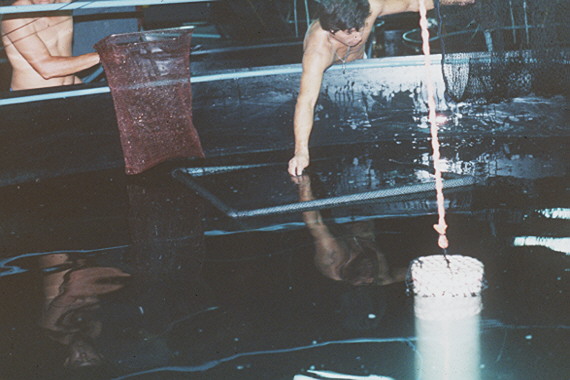 Indoor facilities are usually favoured for maturation systems since they permit greater control of temperature, light intensity and photoperiod, all of which influence ovarian development. Nevertheless, outdoor tanks, pens or ponds can also be used. The successful application of this type of maturation system depends on the availability of suitably sheltered seawater sites (Bray & Lawrence, 1992).
 Wild-caught or pond-reared broodstock are held in shallow (40-70 cm water depth) circular or elongated tanks (3-5 m in diameter), made of fiberglass, plastic or cement, stocked with shrimp at 6-10 m-2. A maturation tank must provide the shrimp with sufficient area and depth of water for successful courting and mating behaviour (Bray & Lawrence, 1992). Operating water depths range between 0.3 and 1 m and best results are usually obtained with a steady temperature around 28°C and a salinity close to full seawater (30-35 ppt).The sides are dark colored to reduce collisions with the sides. Light levels should be dim (0.5 µE/m2 s). Photoperiod can vary from 13-14 hours/day to 24 hours/day. Maturation tanks should be located away from the standby power system, and other sources of vibration and noise. Some hatcheries use a sand substrate for species such as P. monodon, while others do not. Sand substrate significantly increases problems with hygiene and water quality (Colt & Huguenin, 1992). |