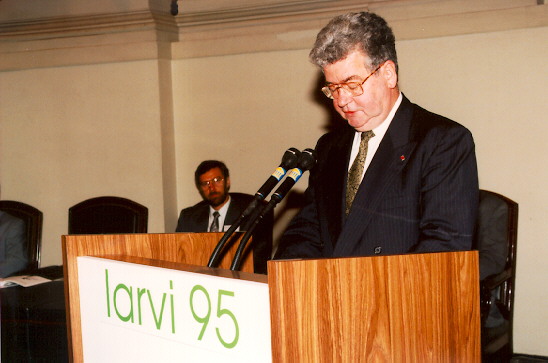

It is with a great pleasure, that I welcome you, guests and conference participants from fifty nine countries, at the historical city of Ghent and at the University of Ghent, founded nearly 180 years ago.
I hope, that you will find the time to discover the monuments and scenic corners of our medieval city.
Gent has indeed a glorious past: in 1350 it was the second largest town in northern Europe and Europe's most important producer of cloth, using wool imported from England.
Gent was the birthplace of Emperor Charles the Fifth, in the year 1500, sovereign of the Burgundian Empire, Austria, Spain, Naples and the new American colonies. The impact of Spanish culture on the city of Gent and its local dialect, dates back to this period of the early 16th century when Charles the Fifth grew up in this town.
Today, the economy of Gent is no longer dependent on the textile trade. We now have very diversified industries: a large iron and steel plant, several petrochemical industries, a car assembly plant, etc. all benefitting from the Terneuzen sea-canal which allowed Gent to become a major port.
Without any exageration, I may say that today, the university is also a major asset of this city.
I would like to introduce this university very briefly to our guests.
Founded in 1816 by King William I of the Netherlands, the University adopted Latin as the language of instruction until 1835, five years after the Belgian Independence, when French became the academic language. It took some hundred years before the switch to teaching in Dutch was made. In 1930, the Rijksuniversiteit Gent or State Ghent University was indeed the first university in Belgium to teach in Dutch.
The number of students has steadily increased and in spite of the the demographic decline in the number of 18-year olds, it is still growing. At this moment some 18,000 students are enrolled in 11 different faculties.
The quality of education and research is an important asset of this University. Several Master of Science programmes are offered in English and more than 400 students from various continents are enrolled as doctoral candidates. Through ERASMUS, TEMPUS, COMETT and LINGUA programmes of the European Union the Ghent University has participated in exchange programmes with more than 200 universities from all member states.
In fact, the very topic of your Symposium is a good illustration of the dynamism displayed at our University:
First launched at our university in the mid-seventies by Prof. Guido Persoone, aquaculture research and education has become an important interfaculty as well as interuniversity activity at our university. Thanks to the efforts of Prof. Patrick Sorgeloos several research groups from the Faculty of Agriculture and Applied Biological Sciences, the Faculty of Sciences, the Faculty of Pharmaceutical Sciences and the Faculty of Medicine cooperate in national and international aquaculture research projects. The Master of Science in Aquaculture programme of the Faculty of Agriculture is a joint undertaking with the University of Leuven in Belgium and the Agricultural University of Wageningen in the Netherlands. Presently we have over 30 MSc and PhD aquaculture students at our university from Algeria, Bangladesh, Belgium, Cambodia, Ecuador, Egypt, Greece, Indonesia, Iran, Marocco, People's Republic of China, the Philippines, South- Korea, Suriname, Tanzania, Tunisia and Vietnam.
Aquaculture graduates from our Alma Mater carry out projects in Africa, Asia and the Americas and cooperate with research groups and private organisations worldwide.
As head of the Ghent University, I am proud of the aquaculture research carried out at our university, and consider the Artemia and aquaculture theme as one of our University's ambassadors.
I am also pleased to learn today that so many people from the private sector are attending this international conference which is organized for the second time on our campus. The purpose of aquaculture research is to lead to useful applications in the industry.
I wish the Organizers success and all the participants a fruitful meeting, which hopefully will stimulate the relations with our university and lead to further cooperation with the research groups at our university.


